Tag Archive for: real estate appraisal

We’re all hearing more and more about the new Uniform Appraisal Dataset (UAD 3.6). Some of you may have even gotten inquiries from lenders or financial institutions already.

Are you ready for it? If not, you’ll need to be very, very soon.

UAD 3.6 is a complete rethinking of how valuation data is structured, communicated, reviewed, and delivered. And whether we love it or hate it, this will soon become the way appraisal work is done.

Will this require adjustment? Absolutely. The first few reports might feel like you’re learning appraisal all over again.

The good news? Once you understand it — really understand it — you might find you actually like the new structure. You might even wonder how we ever tolerated the old forms for so long. But to get there, I’d like to walk through some of the biggest changes that caught my eye.

So grab your coffee, settle in, and let’s take a look.

The Best Place to Start

Want to get some additional education on UAD 3.6? Start with FannieMae.com/UAD. I’ll be referencing this a LOT throughout this article.

This page has lots of documents, videos, sample reports, etc., and it’s all free. But one document should be your new best friend, and that’s the Appendix F1 URAR reference guide. It’s a PDF download with a ton of information. 

Fair warning, if you’re thinking about printing it out, know this: it’s currently 375 pages. I have one printed on double-sided paper, and it’s still huge. The digital copy may be a better option, especially because it’s searchable.

Key Changes to Note:

Material Difference

One of the first things appraisers notice about the new UAD is the way property characteristics are captured. Gone are the days of squeezing every nuance into a comment box the size of a Post-it note. Instead, the new system requires us to think more like data scientists — a structured, repeatable process that logically organizes the characteristics of each property.

That includes thinking differently about what counts as a “material difference.” Appraisers have always had to consider market-relevant features, but now those distinctions need to be expressed in a standardized way.

For example, when the new UAD asks about property characteristics, it’s not just saying, “Describe the house.” It’s asking:

  • What features drive value?
  • What features define the market?
  • What features set this property apart from the competition?

Things like location, site size, garage, and condition might be material. But depending on your market, other factors like barns, outbuildings, fencing, and even access road type could also matter. The important part is consistency: describing similar qualities in similar ways across your reports.

And yes, some of you are already muttering, “Bryan, appraisers have always done this.” True. But the difference is how the information is captured. The old forms forced us to make narrative descriptions do the work of structured analysis. The new system flips that. Narrative still matters, but structured data comes first.

Comp Drive-bys

True story: There was a guy (let’s call him Steve) who was in Horse Branch, KY taking comp photos. He drove up to Hartford and stopped at a funeral home. You may wonder, “why did he stop at a funeral home?” Well, at that time, one of the funeral home’s owners, Danny Schapmire, was also an appraiser. (A great appraiser, actually, and a stellar human. He has since passed.) This county had limited data, and we’d always go ask Danny for data that we couldn’t find ourselves. 

Steve walked in and said, “Danny, I’ve got a subject property. You got any comps you know of?” 

Then, another man came into the funeral home right after him, furious, asking, “Where is he?” 

Danny immediately tried to calm him down and asked what was going on. The man said, “There was some guy in front of my house taking pictures, and his truck’s parked in front of your funeral home. If I find him, he might end up staying here.”

This guy was mad.

Danny was able to calm him down and explained, “Look, you bought your house a few months ago. He’s an appraiser like me. Part of our job is to find comparable properties, and since your house sold a few months ago, he’s using it as a comparable. He’s not casing your house or anything.”

The guy eventually left, and everything was fine in the end. But that stuff really happens, and I’m sure you have similar stories from your own experiences hunting down comp photos. I know I’ve got an abundance of them. 

The new UAD 3.6 changes the game on comp drive-bys. The reference guide states: “The creation of UAD 3.6 has allowed us to revisit this requirement. While we still require clear descriptive color photos of the front of each comparable, we have retired the requirement to inspect the comparable sales from the street.”

Personally, I’m glad they’re retiring that policy.

Ceiling Height

If you were to search for “ceiling height” within the F1 reference guide, you’ll find that one of the references (report field ID: 10.045) details when to include it, and the answer is always. But I’m going to back up real quick and read what it says about starting under walls and ceiling. 

“The appraiser must…” Must is not a suggestion, folks; must means you have to do it — i.e., “provide information about the walls and ceilings in the unit.”

The walls and ceilings row always displays in the interior features table, and you have to choose one or more of the allowable answers. So ceiling height (that is, the approximate ceiling height in the unit, rounded to the nearest foot) is always required.

How are you going to get that ceiling height? Well, I’d guess you’re going to measure it. And for those of us that use a laser or something similar, it should be pretty easy. For those of you using a tape measure — don’t. I like to tease people when we come to this one and say, “If you’re using a fiberglass tape measure, and you have to carry around a ladder and get on a ladder to measure something, videotape yourself. I want to see you doing that.” (But actually, don’t do that. It’s dangerous. Instead, invest in a laser or some sort of device where you can grab that measurement more easily.) 

Is this a big deal? That’s up to your interpretation. But whether you love or hate this change, it is a new requirement. 

Broadband Internet

Let’s talk about one of the more surprising features in the new UAD: broadband availability.

Yes, you read that right. In 2025, internet access joins the ranks of site, view, and utilities. And honestly, it’s about time. If you’ve ever tried to run your business off two bars of rural cellular service, you know that internet speed can be a real market factor.

It’s a simple question – “Is broadband internet available?” — and your answers are yes and no.

If you check “yes,” you’re confirming high-speed internet access is publicly available exclusively through a digital subscriber line, fiber optic, or cable. If you answer “no,” you’re saying public high-speed internet access is unavailable, or it’s only available through a private satellite. If it’s a satellite, it’s a no. You might say, “Well, what if it’s Starlink? Is that a satellite?” Nope, the answer is still no. 

But how do you verify it?

I’ll admit, when this initially came out, I was a little concerned. Here’s why.

A buddy of mine bought a house, and one of his conditions was, “Is there broadband readily available?” The MLS listing said yes. The seller said yes. Everybody said yes. So, he bought the house. But when he was changing the utilities over to his name, he called the internet service provider and said, “Hey, I need to schedule to get the highest speed internet access available to my house. I work at the hospital as an IT specialist, and I’ve got to be ready to spring into action at a moment’s notice, in the event something goes bad.” 

To his surprise, they said, “Sorry, but high speed internet is not available at your house.” 

He naturally responded, “Whoa, I just bought this house. This is a newer subdivision. And I was told I had broadband internet here.” And they said, “Well, it is readily available to your subdivision, and it’s even readily available to your street. The problem is, it’s across the street, not on your side of the street.”

Obviously, he wasn’t happy. In fact, he was pretty upset. The hospital could call him at 2:00 in the morning, and he’s one of the few guys there that has to be available at all times. He had to have high-speed internet. It was quite literally life-or-death, in some cases. So he asked, “Well, what do I have to do to make it available?” 

They replied, “Well, we could get it to your side of the street, and we can have somebody out there next week, but it’s going to cost you $13,000.” Excuse me? $13,000 in unexpected expenses?

So the question is: Would he have recourse against the individual that sold him that house? Honestly, I don’t know. I’m not an attorney or a judge. But he may try.

So, what if I was the appraiser in that case? And I relied on the seller or the MLS, only to find out, yikes, the internet’s not readily available. That would have been bad, right? This is why I was really concerned when I first saw this change.

Personally, I would do two things. 

1. Ask the homeowner.

My company has a questionnaire we give to homeowners. This questionnaire has lots of information that we want to ask anyway. “Has your property been offered for sale in the last 12 months? Have the kitchens and bathrooms been updated recently? When was that done?” Then we include some disclosure statements. And guess what I’m probably going to add to this questionnaire now? “Is there broadband internet available to your house?” I’ll give the definitions as prescribed in the F1 reference guide. This way, at least I have that in my work file. We always make these questionnaires part of the appraisal report.

2. Search the FCC Broadband Map.

If you go to the FCC Broadband Map at broadbandmap.fcc.gov/home, you can search by address. (Yes, it’s an actual federal website. Yes, it’s surprisingly user-friendly. I know, I was shocked too.) It’ll tell you all about broadband availability. You can also save and/or take a screenshot of the page, and add that image right into your appraisal report. I’ll be utilizing this resource in all my reports.

Environment

Another major theme in the new UAD is understanding the broader environment around the subject property. In other words:

  • What influences buyer behavior?
  • What affects value outside the four walls?
  • What external factors shape the market?

This includes everything from land use trends to hazards, public utilities, environmental risks, and much more. The new structure forces appraisers to think comprehensively — not just about the property itself, but about its context.

This isn’t busywork. It’s what we should have been doing all along. The new format simply makes the expectations clearer and the results more consistent.

Change Is Hard

Appraisers are not known for embracing change. We’re in our routine. We love our routine. 

The new UAD is a big change. Yes, it feels like a lot right now. Yes, there will be frustration. Yes, you’ll be tempted to mutter a few choice words at your computer screen. But this is the new standard. This will become your new routine. And once it is, I think you’ll be glad. And I don’t think you’ll want to go back to the way we were doing it before. 

If you want to start digging deeper, visit FannieMae.com/UAD. That’s the official site, full of documentation, resources, examples, FAQs, and even sample reports. Once you see how it all comes together, I think you’ll feel more confident about making the transition.

Be prepared, be ready to adapt, and get out there and make some money. 

Closing Thoughts: Your Biggest Asset

Before we wrap up, let me offer one little reminder: Your number-one asset in life isn’t your business, your license, your expertise, or your fancy laser measuring tool.

What is your biggest asset? You may have a nice car, a nice house, a lot of money in the bank, and those are all wonderful assets. But if you lose your car, you can get another one. If you lose your house, you can get another one. If you lose your wealth, you can rebuild. I’ve been on top of the mountain, and I’ve been at the bottom of the mountain, and everywhere in between (the top’s better, trust me). But that’s just stuff. You can replace stuff. 

Maybe it’s because I’m getting a little older, but there’s one asset I know I can’t get back.

It’s time.

Time with family. Time with friends. Life outside of work. These are the things that actually matter.

You can always write another report. But you can’t get back lost time, missed experiences, or relationships with your loved ones. So turn your phone upside down, or even better, turn it off, and enjoy that most valuable asset you have — time.

Happy appraising. Happy living. —Bryan Reynolds


This article has been adapted from a recent episode of the Appraisal Update Podcast with Bryan Reynolds, which you can view here:


Tim Andersen shares thoughts on some of the biggest issues facing the appraisal industry this fall.

A Good Time to Buy – or Is It?

Our friends the real estate brokers have a mantra: “Now is a great time to buy a house!”

Of course, they don’t get paid if we don’t take money out of our pockets, so they might be a tad biased.

Despite the brokers’ optimism, here’s a Newsweek article with a different perspective: “Only 35 percent of consumers believe it is a good time to buy a home, according to a National Housing Survey report released by home financing giant Fannie Mae in June,” writes Samantha Lock.

So maybe it’s not a good time to buy a house just because our broker friends say it is.

(source:Is Now a Good Time to Buy a House?” by Samantha Lock. Newsweek, 7/28/21.)

Housing Issues: Supply, Affordability, Discrimination

Counselors of Real Estate(R) [CREs] tend to deal only with commercial properties. They aren’t well known in the residential appraisal arena. However, because they tend to look at issues from the 10,000 feet, rather than at ground level as we do, they see things differently. That’s why it’s worth checking out the CRE website — have a look at the 10 issues that article raises. Pay extra special attention to #6. I’ll wait.

In this era of pandemic lockdowns and other upheavals, housing supply and affordability are massive issues that aren’t going away. And whether you agree or not, neither is the issue of housing discrimination. It’s a topic some of real estate’s finest minds are struggling with (and have not yet solved). What’s the takeaway? What are your thoughts?

The Future of Appraisal

This 2020 article from the Motley Fool has a savvy take on the likely future of real estate appraisal: “…it’s likely an appraiser will spend less time at a property using their expertise in the field and more time behind a desk finalizing a property valuation using data gathered by other professionals, such as Realtors or property inspectors,” writes Liz Brumer. That said, she predicts that demand for appraisal services will grow 7 percent over the next ten years, even as the work of appraisal may be changing dramatically. Don’t panic!

(source:The Appraisal Industry Is Changing: What’s the Future of Real Estate Valuations?” by Liz Brumer. Millionacres, The Motley Fool, Sep 07, 2020.)

And Speaking of the Future…

Check out this post I found on the site of the private real estate analytics firm, Cape Analytics. It’s about ideas for how tech innovations might help the industry deal with the high demand for appraisals right now, potentially speeding up turnaround times … and cutting costs.

As the post author points out, the technology already exists to <corporate blather alert> “… remotely and instantly gather geospatial property condition data on tens of millions of homes across the US—delivered with the speed and coverage of traditional property record data. This includes access to neighborhood, census tract, zip code, or CBSA data, both current and aggregated over time to unearth trends that might otherwise be extremely hard, if not impossible, to do with any traditional appraisal model.”

Please note the euphemistic reference to the “traditional appraisal model,” which, the article seems to insinuate, is outdated. The author adds that appraisers’ expertise is valuable (why thank you!) but also subjective (scratch that).

What will these “process improvements that allow non-traditional valuation services” mean for us plain-English-speaking, human appraisers?

I find it interesting that such data and analytics are available to anyone capable of paying for them — except for appraisers, of course, who can’t afford such data. What are your thoughts on this?

(source:Viewpoint: The FHFA and the Future of Real Estate Appraisals,” Cape Analytics)

The Demise of Appraisal — Greatly Exaggerated?

When it comes to the demise of residential real estate appraisal, my friend Dustin Harris, The Appraiser Coach, has a different outlook. He (and his correspondents) opine that the future is not as woebegone as some might think. Of course, Dustin does admit to being an optimist. And the post is from the Time Before, when the world felt a little less crazed.

(source: Is It The End Of the Appraiser?” by Dustin Harris. The Appraiser Coach Blog, 8.30.2017)

A Note on Bias

I’m hesitant to add anything more on real estate appraisal bias, but here goes. What I find disturbing is not so much the number of articles in the media on this, but the fact that the mortgage lending industry is happily letting the real estate appraisal profession “…take one for the team,” even though lenders and appraisers are not on the same team on this.

Back in the day when lenders, and the FHA, were busy redlining certain neighborhoods to protect themselves from what they perceived as excess risk, the appraisal industry was not the architect of that design. Not then and not now. To whatever degree appraisers and agents played a role in a discriminatory system — and we should take an honest, hard look at this — we did not spearhead it. For that, you can look to New Deal-era government housing programs, the FHA, the big banks, the Home Owners’ Loan Corporation. These policies came straight from the top, and the results were the segregation of housing in U.S. cities for generations to come.

We describe the market as we see it; we do not define it. It’s not our job to measure risk. Underwriters do that. It’s not our job to make policy. Lenders and public officials do that. Clearly, appraisers must work to rip out any discrimination there may be in any appraisal. But why are lenders, underwriters, and AMCs not taking more of the heat on this?

We can’t solve this massive societal problem if we just keep passing blame down to appraisers.

(To learn more about the history of redlining, see this exhaustive study, Mapping Inequality: Redlining in New Deal America, complete with lots of sadly illuminating HOLC neighborhood maps.)

Some Words on Words

Speaking of avoiding bias (how’s that for a smooth transition?), you’ll want to read this article on words Fannie Mae says we shouldn’t use anymore.

Actually, she’s right.

Saying that “the subject is in a desirable neighborhood” communicates nothing (and foretells a lack of supporting analyses). What’s also missing from that boilerplate sentence is a summary of how and why the appraiser reached that conclusion. Remember, per SR2-3, every statement of fact in an appraisal report must be both “true and correct” or it is likely misleading (and USPAP’s current definition of misleading is draconian!).

And besides, the words “desirable neighborhood” call forth some old notions it’s time we put aside for good.

(source:Why Fannie Mae Doesn’t Want Home Appraisers Calling Neighborhoods ‘Desirable’,” by Brentin Mock. Bloomberg, July 23, 2021.)

And Now for a Shameless Plug

I want to see you at the annual Appraisal Summit, please! I’m ready to shake your hand and see your face up close and personal (in other words, not on a ZOOM screen!) It’s happening on November 6 – 9 at Planet Hollywood in Las Vegas, and the National Association of Appraisers (NAA) and the Columbia Institute have a real blowout planned for us, with special events for supervisors and trainees.

See you there! (Full disclosure: I’m on the NAA board of directors.)

What are your thoughts on these and other hot-button issues our industry is facing this fall? Share them in the comments below!

About the author:

Tim Andersen is an AQB-certified USPAP instructor, consultant, and reviewer. He travels throughout the US teaching USPAP. His other areas of expertise include writing, producing, and presenting webinars on all areas of real estate appraisal. Find out more about his mentoring, consulting, writing, and podcasting at his site, The Appraisal Advocate

In our Appraiser eLearning survey, real estate appraisers across the country report more work than ever before, a few savvy adaptations, and a shift in life priorities.

We had more than eighty responses from appraisers all over the United States. Respondents were split nearly 50-50 between folks whose main source of income was assignments from AMC vs. assignments from lenders, with a few reporting that they mainly do litigation support. More than half work as solo practitioners and about one-fifth in firms of 2-5 employees. Most respondents said they had not retooled their firms for remote work — presumably because many solo entrepreneurs already worked from home before the pandemic. A few did retool how and where they worked, at least partially, and some said that prompted them learn new tech and new ways of delegating — and allowed them to become more productive than before.

Here’s where it gets interesting. More than half — 57% to be exact — reported having more work in the past year than they did before the pandemic. Lots more. “We inspected 450 properties in 2020,” said D Lawson from Texas. “That is 150 more than our normal year. And nobody in my 3-girl office got Covid.” And TMM, also from Texas, wrote, “The pandemic has been the best cash cow in 16 years in business.”

Several people reported doing more desktop and drive-bys this year, and many said that costs were down and income was up, or WAY up. “We are able to choose work and raise fees with little pushback,” wrote Greg, an appraiser in Texas. “Business is great, and I haven’t changed anything because of the pandemic. “We had already changed to a work from home situation. Our costs have never been lower and fees are the highest ever.”

Below, we’ll break down the numbers and dig into some of the detailed responses that people sent in. We think you’ll find it fascinating and illuminating, and probably familiar.

Thanks to all who took the time to answer this survey!

How did your work/income change over the past 12 months?

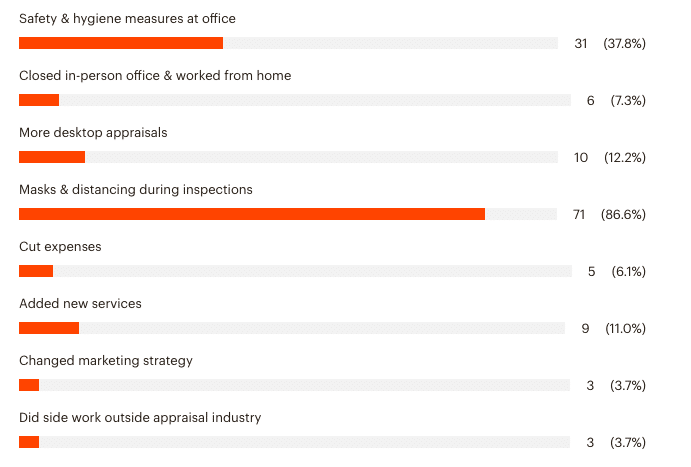
What are some ways you adapted your appraisal work or business strategy to this pandemic year?

Which of these professional challenges did you face over the past year?

“People are chasing appraisers on foot and in their cars. They beat on the appraiser’s window, windshield and other parts of the car. If the appraiser opens the window, they hit the appraiser repeatedly in the head. They file false police reports that the appraiser threatened them. I was in an online class where everyone had a similar experience weekly. It’s unsafe to be an appraiser now.” —Sandy (CA)

How will you prepare for future unknowns that affect our industry, such as recessions, interest rate hikes, housing crises, or other global emergencies like COVID?

Going forward, what will change about how you do business after the pandemic

“I think that we will continue to support our staff working from home and likely downsize our investment in facilities in favor of technologies to continue to support our network.” —DRD (MO)

“We sold our office building during the economic crash of 2009, over 10 years ago and while it hurt at the time, it wound up being the best decision we ever made. We consider ourselves blessed to have made that decision when we did. We worked off a remote server, communicated by phone and email constantly and met regularly, but never missed a beat. It was different but helped us get ‘lean and mean’ opening up the budget for better equipment and higher salaries.” —Victor Andrews (TN)

“Roll with the punches.”

—Scott Cullen (MN)

I concentrated on local lender clients that value my services (as opposed to AMC’s). I added additional services for them (evals and restricted desktops); this was much more lucrative and rewarding.” —MWW (AL)

“This past year I took off more weekends, which allowed me to de-stress and actually do some relaxing. I tried to look at 2020 as a “gap-year” where I accepted less work, but was able to have more downtime.” —Linda K (TX)

Going forward I’d like to incorporate more technology and get a trainee on board.” —MER (MO)

Were there any surprise revelations for you this year—the good kind? Lessons learned, shifts in priorities?

These answers were wildly variable. Lots of people said, simply, “no.” Others spoke of gratitude — for having a livelihood still when so many did not, and of being able to do the work safely (for the most part). Several appraisers mentioned taking much-needed down time during 2020 and enjoying time spent with family. A few were disappointed with how they were treated by clients and the people whose homes they inspected, while others saw their faith in humanity renewed by kindness.

“Who knew that the housing market would be booming during a pandemic?”

—SMK (OH)

“I continue to be amazed at the lack of knowledge in general about what appraisers do. Literally no one cares about us. They didn’t care if we got sick; didn’t care if we spread Covid to the universe; plain flat didn’t care. I contacted CAL BREA to see if we had any kind of special dispensation to receive the vaccine and they could have cared less whether we lived or died … I never received a single order that did not require me to do an interior inspection. Very disappointing!” —Allison (CA)

“Our biggest surprise of the past year was the amount of work out there for the appraisers who wanted to challenge themselves and not just take cookie cutter assignments. I personally learned that family is important. The year brought challenges due to elderly parents and providing care for them while trying to keep a business running smoothly.” —D Lawson (TX)

“Realized that remote workflow with tech tools and delegation works great. Actually increased productivity and volumes dramatically this year. Perspective changed with new model.” —Glen Calderon (MD)

“Learned to be more efficient and streamline the appraisal process. Was able to spend time on education and learning new systems. This year is starting off good.” —Norman Jones (KY)

“I don’t look half bad on Zoom.”

—dcs.value (NC)

“I was surprised how many people had no problem or issue with me coming into their house during a pandemic as long as they can get that lower interest rate. I had only a handful of borrowers cancel when they found out I had to come inside. I also finally realized that the work will always be there, take some time for yourself to recharge. Step away, put yourself as ‘on vacation’ or ‘out of the office’ with your clients. The time you missed out on doing things you love and just being with loved ones because you had deadlines, can’t be retrieved. It’s gone. Make some money – but don’t forget to make some memories”. —MER (MO)

On a scale of 1 to 10 (with 1 = maximum concern & 10 = extremely optimistic), how do you feel about the near future of your business?

Bryan Reynolds asks appraisers to consider a retirement phase-out plan that may benefit you, aspiring appraisers, and the community you serve.

I was teaching a live CE course recently, and a gentleman in the audience said, “This is my last rodeo. This is it.”

I said, “What do you mean?:

“I’m done after this one,” he said.

“Oh, you’re planning on retiring before your next requirement for CE,” I said. “That’s exciting, congratulations! What’s your exit strategy?”

He said, “My what?”


What’s your exit plan? Or do you have one? Are you planning to just turn off the lights off, shut the door, and say “I’m done?”

Maybe you ought to reconsider that. What if you created an exit strategy that might help you, might help others, or may just help the community in which you’re providing service?

I have this conversation a lot when I’m coaching, consulting, and teaching. I bring this up often. And I’m surprised to find that many folks have not planned for their retirement. When I say, “What’s your exit strategy,” most of the time the answer is, “Well, I’ve got a will.”

Don’t get me wrong — you need to plan for that exit strategy as well. Have you named beneficiaries? Do you have a will? It’s all about planning ahead. My mother has done a great job of planning ahead. She bought me a cemetery plot, and I said, “Thanks, Mom!” She’s got various policies so that she’ll never have to go to a nursing home. She’s got a plan of action to bring in home-care. She thought ahead and made a plan.

That’s what I’m suggesting that appraisers should do with their businesses, instead of just closing the doors. Most appraisers run small firms. They do everything themselves. They’re the president and the janitor. There’s nothing wrong with that. But instead of just closing up shop and moving to Costa Rica, what about a different plan?

Phase Yourself Out, Bring Someone In

The biggest obstacle to people getting into this profession is finding a mentor. I genuinely believe that once we’ve been in this business for awhile, if the business has been good to us, why not give back to the profession?

We need to help others. After all, someone took a chance on you, didn’t they?

Maybe we should explore this idea. Maybe you could bring someone in and start molding them. Maybe two or three someones. Yes, it’s going to take a little time. Yes, it may increase your liability a little bit. But maybe it’s an opportunity for you to say, “When I’m done, we’ll create a company for you.” Maybe you put a tail on that. I mean, how cool would it be, while you’re on the beach, to get a check once a quarter? So early on, Trainee, I’m gonna take the lion’s share of the income, and you’re not gonna make much. But eventually, you’ll make most of the money, and I’ll walk away. Like my mentor George always told me, “Bryan, you’re gonna do all the work, and I’m gonna take all the money!”

But I learned more about appraising from that gentleman than I ever learned from any book or class. There’s no way I could ever truly pay him back. Except, maybe, to pay it forward.

So maybe you bring somebody in and you mentor them. Maybe you keep a certain percentage for a few years, whatever you two negotiate. Buy you’re still a phone call away. You’re a consultant, an advisor, a mentor. Remember, the learning really starts once you’re certified. You don’t know everything you need to know once you pass that national exam and get your license issued.

We should all be lifelong learners. And when I learn something, I want to share it with others.

So instead of closing the door and moving to a warmer climate, maybe you can take a few steps and leave that door open. Maybe you set yourself up to get a residual income and help a person build a business. And you’ve helped your community by finding your replacement, someone who can carry on providing the service you’ve provided for a lifetime.

Something to think about instead of just saying, “I’m done” and closing your door.

A Parallel Strategy for Trainees

Meanwhile, for you trainees out there, or for anyone thinking about entering the profession: You need to change your approach to mentors. Don’t call and say, “I need a mentor. I need hours.” Most likely, that business owner doesn’t care what you need! I give to charity already.

But here I am in danger of contradicting myself — I do believe that we need to give back and provide opportunities for other people. But this is a two-way street: Don’t approach a supervisor saying, “I need I need I need.” Let them know what you bring to the table, what value you can add. How you can assist them in making more money.

Think of this as your onboarding strategy. Why not ask them, “How much longer are you going to be in this business? What’s your exit strategy? Maybe I can help you transition out. I’ll do the heavy lifting now, and when it’s time for you to retire to the beach, you can keep mentoring me in return for a little piece of the pie.”

Trainees, that might just be an opportunity for you to get yourself a mentor. Get an onboarding strategy. And veteran appraisers, think about your exit strategy. Both categories: Plan ahead. And maybe, on occasion, those plans can come together — to everyone’s benefit.


About the Author:

Bryan S. Reynolds, CDEI™ is a KY/TN Certified General Real Property Appraiser, a registered agent with the TN State Board of Equalization and an AQB Certified USPAP Instructor. He has testified in various courts, planning and zoning boards as both an expert and as an agent making valuation arguments before local and state hearing officials and Administrated Law Judges. Reynolds is the owner of Bryan S. Reynolds & Associates, Reynolds Appraisal Service and a partner in Appraiser eLearning. He provides residential and commercial valuation services, educational offerings, mentoring, consulting, and litigation support services throughout the country. He is available for lectures and is well known for his Think Outside the “Check” Box approach.

Bryan shares a story about how a little extra forethought might head off major headaches down the road.

The Trainee

Recently, my trainee Kelsey told me she had an appraisal ready for me to review. I asked her about the two busy roads that abutted the property. “Did you make an adjustment for that?” I said.

“No, I didn’t,” she said.

“I wouldn’t have either,” I said. “But did you make a comment about it?” She did not.

And then I suggested that we probably should. “And now I’m going to tell you why.”

And so I told her a story about one of the very first appraisers I helped who had a complaint filed against her.

The Complaint

This is the story: I had an appraiser contact me, and she’d had a complaint filed. The reviewer alleged that she did not analyze and report that the subject property’s area, the whole subdivision really, backed up to a railroad track. And she called me and told me about it. And I said, “Stop talking. Let me talk.”

“If you missed it,” I said, “if you didn’t realize that the property backed up to a railroad, and you didn’t analyze that it could impact the marketability, you need to raise your hand and say, ‘I missed it. I made a mistake.’ You need to ‘fess up to that and accept the consequences, if there are any, and use it as a learning experience, and move on.”

That’s what we need to do. We need to be honest. And we need to tell what we did or didn’t do. When we make a mistake, we need to have the courage and the honor in saying, “I made a mistake. I’m human.” Because we all make mistakes. No one’s perfect. Practice makes better. There’s no such thing as perfection. Practice doesn’t make perfect.

On the other hand, if you did know that rail was there, if you did analyze that, if you did opine that there was no adverse condition as a consequence of that subject’s proximity to that rail, I don’t think you did anything wrong.

The Argument

Keep in mind that all of her comparable sales were in the immediate area. So if the subject suffered from some negative influence because of the nearby railroad track, all of her comps would have suffered a similar influence. Her value would be unchanged. She wouldn’t have made any adjustment. So really, we’re just talking about a reporting issue.

Now, maybe I would have handled it differently. Maybe the members of the regulatory commission would have handled it differently. Maybe the investigator would have handled it differently. However, we’re not here today to discuss whether this individual used best practices. We’re here to discuss whether the person met the minimum requirements of USPAP.

You see, if we talk about the pre-printed form, under the site section, it says, “Are there any adverse conditions or external factors, yes or no?” Well, in her heart, if she didn’t believe that had any impact on the subject, if she analyzed that and said there was no issue, she doesn’t have any obligation to report anything. The obligation is to report if it does have an adverse effect.

One of the things I argued on behalf of this client was, if you think she’s trying to hide that this property backed up to a rail, why didn’t she white out the railroad on her location map? The map clearly showed a railroad there. She wasn’t trying to hide it. She just didn’t think it had a negative impact.

Her case was dismissed. What I told her was that in the future, she could avoid this problem very easily. All she would have to do is say, “Hey, client. The subject property, the subdivision, backs up to a railroad track. I’ve analyzed this, and in my professional opinion, I don’t think there’s any negative impact.” That way, she tells the world, the client, that she didn’t miss it. She knows it’s there, she just doesn’t think it has an impact.

The Moral

The moral of this story is, if you think ahead, you can put this fire out before it begins. If she had said, “Hey, everybody, there’s a railroad track back there, but it’s not impacting the marketability,” then no one could have pointed at her and said, “She missed it.”

Now, you can argue about whether or not the railroad affected value. That’s a matter of opinion.

So what I suggested to Kelsey was this, in an effort to head off any problems, why don’t we say that the subject property backs to Carter Road, side to Southtown? Both of which are somewhat well-traveled, but an analysis of this revealed no negative impact. Because there’s areas of Carter Road that do affect marketability but up here, not so much. At least, that’s our opinion.

I was going to buy a house one time, and I thought, “I’ll get a good deal because it backs up to a bypass.” The bypass sat back a ways, and I thought, “That’s the Owensboro Beltline! That’s got to have a negative impact. I’ll be able to negotiate a good price on this.” No. It didn’t appear to impact the price at all. I wasn’t able to buy that house.

I get it. This is a case-by-case issue. You’ve got to look at your market, that segment of the market, and analyze your data to see whether there’s a market reaction or not.

The Dead?

What if your house backs up to a cemetery? (And by the way, what’s the difference between a cemetery and a graveyard? What does “Saved by the Bell” mean? To get the answers, you’ll have to listen to the episode!)

Either way, acknowledge the cemetery and analyze whether it has a negative impact. I certainly wouldn’t mind the quiet neighbors, but other people might be creeped out and might not want to buy that house.

The Fix

Just a thought: Let your client know, “I’m aware that the property is adjacent to a cemetery, or a well-traveled road, or a railroad track. And here is my analysis of whether or not that thing affects the value.” That way, nobody can point a finger and say that you missed it. That way, you can say you noticed it and then offer your opinion about the impact of its proximity.

External obsolescence — a loss of value caused by something outside of the property lines — isn’t something you can fix. All you can do is acknowledge it and analyze its impact on the property.

Be transparent about your thinking and your analysis, and you’ll head off a lot of problems before they ever arise.

Want more like this?

Check out Bryan’s webinar (below) about covering your appraisal (CYA) and his Cover Your Appraisal course at Appraiser eLearning.

In “The Appraisal Update,” Bryan Reynolds asks four ACTS attendees to share their reasons for coming to the conference and their takeaways from the week. Here are a few highlights of Bryan’s questions and his interviewees’ answers, condensed and edited for clarity:

Why did you decide to attend ACTS this year?

Jason Covington, an appraiser in Nashville, TN and first-time attendee:

“The timing was right for me to go experience what everybody’s been talking about, to meet the people who’ve been doing this longer than me, people I can learn from … names you’ve heard of, people you work in and around but never have met directly. This gave me the avenue to have conversations with those people and actually see the answer to the question, ‘How do I make change? How does my voice impact my industry? How does my voice count?’”

Nakia Manning, a trainee in Atlanta, GA and first-time attendee:

“I found it was necessary for my growth as an appraiser to go out and meet other appraisers. Up until now, my only contact with the appraisal world had just been my mentor. I felt like it was essential that I join this organization so I could learn more and come to this event, For me, it wasn’t the continuing ed. It was more that I felt the need to meet other people in my profession.”

Mark Skapinetz, an appraiser in Atlanta, GA and first-time attendee:

“For me [the motivation was], meeting people I’ve been wanting to meet for a long time. Having good conversations. You are building relationships with people you can call when you have a problem. I’ve had those people. Now I’ve gained more people to go to when I have a problem, to help me solve it. That alone is worth its weight in gold.”

How was your experience?

Ken Williams, an appraiser in Jackson, MS, second-time attendee, and splendid fisherman:

“This was probably my greatest experience at an ACTS conference. This meeting was really special. Of course, catching that fish didn’t hurt things at all.

“The first conference I was a newbie and everybody was a stranger to me. But I came back with a lot of knowledge and brought it back [to Mississippi] … This time around, I knew a lot of the people. It really brought the camaraderie together. I could loosen up a little bit and freely mingle, having fun and not being offensive. Come to find out it’s hard to offend you guys. But the camaraderie, the information, is what it’s all about. I think [NAA is] a wonderful organization, it’s going to do good things. And I do know that in numbers we’re going to accomplish a lot more. And I think we have that with this association.”

Mark Skapinetz

“I loved it. I liked the setup, I liked the way it was run. I liked the topics I was there for. That mock trial, along with what Craig Capilla added in his presentation after that, hands down, was the best thing I’ve heard in so long. It was something well needed, from somebody that knows what he’s talking about. Hopefully we do another mock trial. Most people have never been in front of a board. You don’t know what you’re up against. That opened my eyes as well. Really well done.

“It was different from other conferences in the sense that it didn’t seem so robotic to me. I liked the intimacy of it. I like that everyone was getting to know each other. I’m looking forward to next year.“

Nakia Manning

“It was amazing! … As soon as I was introducing myself, the central theme was, ‘Hey, you’re a trainee. Take my information. If there is anything I can do to help you, just give me a call.’ What stood out to me about the conference? It was the family atmosphere. It was still more than just a profession. It was all love, it was all community and family. It felt like more than just work. It felt like people who were genuinely interested in my well-being as an appraiser, and my well-being as an individual as well.”

“It felt like more than just work. It felt like people who were genuinely interested in my well-being as an appraiser, and my well-being as an individual as well.” —Nakia Manning

Jason Covington

“I found myself in an environment where I felt like I mattered and my voice was heard. There were platforms where I could get involved and petition for change. It felt wonderful to be a part of something like that.”

Will you come back to future ACTS conferences?

Nakia Manning

“Indeed! I’m from South Carolina, so it will be a pleasure to go to Charleston. Hopefully I’ll be able to puff my shoulders up and actually be an appraiser, not a trainee.”

Ken Williams

“Did you have to ask that question? <laughs> Absolutely! I’m already looking forward to [the next] one.”

What would you tell other appraisers about this conference?

Nakia Manning

“If there are any trainees listening, don’t wait like I did until the end of your training period to realize the need to get out and meet other appraisers. People have different ways of arriving at their opinion, and it would help you tremendously to see things from other perspectives. It was education about what we do, but there was also education about how to run your business — not just the job itself, but how to be more effective from a business standpoint. Really great people, really good information, and the CE is just the icing on the cake.”

Jason Covington

“Take a chance. Break out of the normal routine. Take a few days to meet some people. The topics and the speakers were top-notch. Wonderful information! The information I received was incredible. Give it a try!”

Ken "Big Fish" Williams
Ken “Big Fish” Williams

About the Author:

Bryan S. Reynolds, CDEI™ is a KY/TN Certified General Real Property Appraiser, a registered agent with the TN State Board of Equalization and an AQB Certified USPAP Instructor. He has testified in various courts, planning and zoning boards as both an expert and as an agent making valuation arguments before local and state hearing officials and Administrated Law Judges. Reynolds is the owner of Bryan S. Reynolds & Associates, Reynolds Appraisal Service and a partner in Appraiser eLearning. He provides residential and commercial valuation services, educational offerings, mentoring, consulting, and litigation support services throughout the country. He is available for lectures and is well known for his Think Outside the “Check” Box approach.

Bryan Reynolds reflects on why we appraisers should focus on our top abilities and delegate the tasks we aren’t so great at.

Have you looked in the mirror lately? I mean, really just stood in front of the mirror and taken a long, hard look at yourself?

Do you like what you see there? The wonderful thing is that if you don’t like what you see, you have the ability to change it.

As a business coach, I often tell clients: If you’re not performing at your peak ability, maybe you should look in the mirror and say, “You’re fired.”

I say quite frequently there are no two pieces of dirt on the planet exactly alike. No two pieces of real estate are the same. That’s what makes real estate so different from other goods and services that we buy and sell every day. Each property is unique, just like we are as human beings. We all have strength and weaknesses. And we, as human beings, resist change.

Extinction Is Not Inevitable. Case Study: One-Hour Photo Labs

But no matter how much we resist, change keeps happening anyway. We can be ready for it, or we can push back. Remember those old one-hour photo places? How many of those are still standing? Well I know one that adapted to change. It belonged to a guy named Eddie. He started working on digital cameras, selling them, converting old DVDs and VHS tapes to digital formats, taking old torn photos and making them look brand new. When my mom was on husband #2, after my dad died, she had a photo taken of all her grandkids. Her brother’s son was in the picture with his new wife, who did not last long as part of the family. My mother took this picture over to Eddie, and she said, “Eddie, you see that girl standing next to my grandson? That was his wife. Can you make her disappear, and move my other grandson over a little bit?” And he did it! I was like, “Mom! You can’t just make people disappear!” But I guess in a photograph you sure can.

Or at least, Eddie can. And he’s still got a thriving business, while all the other one-hour photo labs are long gone.

So here’s what I want you to think about: We resist change, external change and changes within ourselves. It’s human nature. But sometimes, we do ourselves harm by refusing to change.

Do You Need a Trainee?

I want you to ask yourself: Are you performing at the highest level that you could be? In my coaching practice and my appraisal classes, I talk to a lot of people. A guy approached me after class once and said he was thinking about bringing on a trainee. He’s in his 70s and had health issues but was still in business.

Let me just pause here to say that I’m a big-time supporter of trainees, and I’m all for YOU bringing on a trainee. I’m creating the Trainee Committee and the Trainee Network for the NAA. I want us to do all we can to support trainees and supervisors, and if you want to expand your business, it’s something you should think about.

But you need to be sure you actually need a trainee. Because may need another kind of hire altogether.

So I said to this man, “Sir, I don’t mean to be rude, but you don’t need a trainee yet. You need a helper.” He was making all the phone calls to schedule appointments. He was handling all the requests from lenders to prepare and send bids, accepting orders, starting the files, and setting them up in the appraisal software.

“That’s kind of a waste of your time,” I told him. He didn’t need a trainee for all that. He needed a helper: someone to answer the phone, reply to emails, schedule his weeks, take all that busy work off of his shoulders.

Triage Your Time

I’m not saying he, or I, or any of us are too good to do these things. I’m not too important to answer my phone. I DO answer my phone, in fact. I’m no better than anybody, and nobody’s better than me.

It’s just that these things are not the highest and best use of your time.

I wrote an article many years ago about a dentist, a surgeon, and a head chef. The whole premise is: identify what only you can do, and DO THAT. Over and over, every single day. Then build a team to back you up, so you can take the busy work off your schedule and let a highly organized person do that for you.

When I suggested this, the man’s eyes lit up.

I’m excited to see where he takes his practice. And maybe you should be having this same conversation — with yourself.

“Identify what only you can do, and DO THAT. Over and over, every single day. Then build a team to back you up, so you can take the busy work off your schedule and let a highly organized person do that for you.”

So look at yourself in the mirror. Maybe you should fire yourself from the work you shouldn’t be doing, work you should hire someone else to do — so you can do the actual work of appraisal and analysis.

Maybe you should fire yourself from the part of the work that you don’t like doing, and get someone else who has that expertise to step in. I could try to figure out accounting, but I don’t want to. So I hire a professional accounting firm. I don’t want to schedule all the appointments and make all the phone calls. I’ve been there; I’ve done that. And it’s not that I’m too good to do it; I’d just rather use my time for something else.

Look in the mirror. Take an assessment. And don’t be afraid to make some changes. Don’t be afraid to implement some new ideas or strategies. Worst case, you can always go back to the old way if you want to. But there’s a part of me that would bet that you won’t want to.

And if you’ve never read Who Moved My Cheese? by Spencer Johnson, M.D., I highly recommend it. Read it, and then think about making some positive changes that will take some of the headache out of your life. And consider building a team to help you with that.


About the Author:

Bryan S. Reynolds, CDEI™ is a KY/TN Certified General Real Property Appraiser, a registered agent with the TN State Board of Equalization and an AQB Certified USPAP Instructor. He has testified in various courts, planning and zoning boards as both an expert and as an agent making valuation arguments before local and state hearing officials and Administrated Law Judges. Reynolds is the owner of Bryan S. Reynolds & Associates, Reynolds Appraisal Service and a partner in Appraiser eLearning. He provides residential and commercial valuation services, educational offerings, mentoring, consulting, and litigation support services throughout the country. He is available for lectures and is well known for his Think Outside the “Check” Box approach.

Bryan Reynolds suggests two changes lenders should make to help appraisal companies operate more efficiently: Let appraisal trainees do inspections and appraisal firms make assignments.

Listen, lenders! No, I’m not talking about the adorable Listen Linda Kid, although he is absolutely fantastic. But I am gonna rip off his best line: Listen, lenders!

In fairness, I give everybody a hard time: appraisers, agents, underwriters. Today it’s the lending community’s turn — you lenders out there, hear me out.

It’s not news to anyone to say that we’re in unprecedented times. Everybody’s waiting for appraisals. Everyone wants to solve the backlog problem with new ideas and products and hybrids. Everyone has “the solution.”

Let’s look at this for a minute. You know why supervisory appraisers are apprehensive about taking on appraiser trainees? It’s because, what value do they add? If I’ve got to go out on every inspection and hold the trainee’s hand, they really don’t add any value to me as a business owner.

USPAP, Fannie Mae, Freddie Mac, your states all allow appraisers to send trainees out on their own, after a certain period and once you feel the trainee is competent . But the lending community continues to push back on this. If the lenders are willing to send an insurance agent out to do inspections, why in the world are they not letting me send my trainee out to do an inspection without me?

Lenders, just listen a minute: A lot of these problems would be solved if you let us appraisers do what USPAP, Fannie Mae, Freddie Mac and our states allow for. Let me teach a trainee the proper methods of observation, and let me send them out. I can hire three trainees! I can expand my book of business!

But if I have to accompany them on every inspection, why would I bring someone on to train at all? Dustin Harris makes the point beautifully on his blog at theappraisercoach.com:

“Our clients (AMCs and Lenders) have made it next to impossible to take on a new recruit. Most of the engagement letters I receive have the following little statement attached, ‘The Certified Appraiser must physically inspect the property, all comparables, and complete the appraisal report. The use of Trainees for this assignment is not allowed.’ So, let me get this straight: I can hire and train a new appraiser, but they cannot do anything to help my business grow until they are fully Certified. Gee, sign me up!” —Dustin Harris, The Appraiser Coach Blog

Well said.

Here’s another thing, lenders (and maybe this goes out to AMCs as well): If I want to hire three certified appraisers, and now I can hire three trainee appraisers for each of them, that’s nine more trainees and three certified appraisers. I have an army now! I’m ready to take on lots of work. But here’s the problem: The lender is going to send the appraisal request to the specific appraiser. Why don’t they send it to the firm? Why don’t they send it to me?

For instance, I have an appraiser. Matt. You send an order to my firm, I could say, that’s outside of Matt’s immediate area. He services that area, but that’s an hour drive. Let me send Kelsey! She’s ten minutes away from that property. So let me assign it based on what makes more business sense. Or maybe Matt’s two weeks behind and Kelsey doesn’t have anything to do. Doesn’t it make sense that I, the business owner, make the assigning decisions, for efficiency purposes?

Listen, lenders. We can solve a lot of problems if you do two things:

1. Let appraisal companies make assignments.

Start assigning the appraisal to the firm, and let the firm decide he best person for the job. Think about it. You send over a fourplex. Kelsey’s only done one in her life. Matt’s done 400 in the last three years! Wouldn’t it make sense for me to assign that multiplex to Matt? I as the business owner know how to delegate those assignments a lot better than you do.

So why don’t we look at approving appraisal firms instead of individual appraisers. If you need to vet them, I understand that. But approve my firm, let me hire more appraisers, and I’ll delegate the assignments out responsibly.

And then finally, listen lenders:

2. Let trainees do inspections.

Let me start using my trainees to their full potential. Trust me to choose them, then let me trust them to do the work I assign. This helps you, it helps me, and it helps the communities we serve.

Most of all, if lenders and AMCs don’t make it less onerous for us to take on and train new appraisers, then how do they expect new appraisers to enter the profession? Our industry is aging. We need excited, sharp young people to take up the trade. Which means we veterans are gonna need to show them the ropes. But we can’t do it out of charity. There need to be incentives for all of us — supervisory appraisers and trainees.

Just listen!

Business is booming for real estate appraisers right now. But the “shadow inventory” is looming. Do you have a backup plan?

If you’re a real estate appraiser, you’ve probably been busy for awhile now. Real estate agents are crazy busy. We appraisers have been swamped with purchase transactions as well as refinancing. Interest rates are on our side.

Remember the 1980s, when interest rates were sky-high? When 10 percent seemed like a great rate? Six percent for long-term mortgage money is really a great rate, historically speaking. I’m like you: I want 2.5 percent, but four or five, even six percent? We have been in fantasy land. I’m sure consumers are loving it. Appraisers are loving it. Real estate agents are loving it.

In terms of the market, Covid has done the opposite of what we expected. We thought nobody would want to sell their houses. We thought people wouldn’t want agents coming into their houses to show. We thought people would wait until this was all over to put their houses on the market.

To a degree, we thought wrong. Certainly some people probably didn’t want agents and lookie-loos traipsing through their houses during a pandemic. But here’s the thing: Scarcity equals value. And in the wake of Covid, people are changing their ideas about where and how they want to live. So there’s a lot of desire right now, and there’s a limited supply.

But what is lurking in the shadows?

I’m not trying to scare you, but if you haven’t heard of this term, Google it: Shadow Inventory.

What does that mean? In this context, it means delinquent loans. REO properties. Foreclosures on the horizon. Loans that were delinquent but there’s a reasonable expectation that they’ll become delinquent again. All of these make up what is known as “shadow inventory.” And this shadow inventory is on the rise.

It makes perfect sense. With Covid, a lot of folks haven’t been able to work, haven’t been able to make their mortgage payments. Renters are behind, landlords can’t kick them out, and that leaves property owners in a fix. Forbearance programs on government-backed loans have held off a wave of evictions and foreclosures, but when those programs end, an estimated 1.8 million mortgages will be in delinquency. And the delinquency rate for FHA mortgages has soared.

What’s gonna happen when those moratoriums lift?

The Real Deal: New York Real Estate News reports mortgage delinquency rates jumped to the highest in two decades. As we look at some of these numbers, it gets our attention.

I don’t know what will happen. Maybe big government will step in. But what if they don’t? Are we gearing up for a new housing crisis? At least banks aren’t making crazy loans anymore. Stated income. 125 percent loan-to-values. So it’s different now. But is it that much different?

Appraisers, you’re probably gonna be fine. If a lot of these houses go into foreclosure, you’re probably gonna have REO work to do, foreclosure work to do. But the shadow inventory is something to think about, and I encourage you to diversify your practice. If all your eggs are in one valuation basket — if you’re only doing refinances, if you’re only doing purchase transactions — what happens if (when) these rates start to go up?

“If you’re only doing refinancing and purchase transactions, you might want to diversify your practice.”

I hope it won’t be this year or next year. But at some point, these rates are going to go up. And if you’re only doing refinancing and purchase transactions, you might want to diversify your practice.

What skill set do you have that may help you in other areas? Maybe you get your home measurement credential. Take a class, take a second class, contact Hamp Thomas and take a written exam (it’s administered online right now), and you can become a home measurement specialist. There’s a whole book of business right there. Go to the brokerage firms and offer to measure houses. Offer to do a restricted appraisal report.

Look at the opportunities available to you. Maybe you take your appraiser hat off and provide consulting services. Maybe you become a real estate agent. Maybe you get into the tax appeal arena. There are so many ways to make money in this business.

One thing’s for sure: Most things change. If you don’t believe that, look in the mirror. Be ready and willing to adapt, or resist and be left behind — you get to decide.

In the meantime, Google “shadow inventory.” Do a little research. That inventory is growing. It’s gonna be interesting to see what happens.

We’ve been living in extremely interesting times for over a year now. Covid will hopefully go away soon, although perhaps not entirely. But the effects will linger, and the aftermath may also be … interesting. Be ready. Start increasing your knowledge base. Open your mind to opportunity.

We’ll talk about the near and far future at the ACTS Conference on April 14-16 in Bay St. Louis, MS. We’ll celebrate the past ten years of the NAA and discuss the future of our profession. Please join us! We’d love to have you.